Welcome to Our Church


Early History of Rock Island Presbyterian Church
A story of place, people, persistence, and quiet faith
Long before a church bell ever rang in Rock Island, Tennessee, Sundays passed quietly.
Until 1921, there were no regular church services, no organized Sunday School, and no weekly gathering for worship in this small community tucked at the foot of the Cumberland Mountains, cradled between two rivers. Rock Island was known instead as a summer retreat, a place where families from across Central Tennessee escaped the heat to rest among cool waters and mountain air. Faith, when it appeared, arrived only in passing, carried by the occasional traveling minister. For most residents and visitors, worship required a journey of several miles beyond the community.
In 1919, an effort was made to change that rhythm. A minister from the Christian Church in McMinnville, fourteen miles away and the county seat of Warren County, organized a Sunday School with the help of a few local members. Beginning November 23, 1919, lessons were held faithfully each Sunday. But by May 2, 1920, attendance waned, particularly as summer approached, and the effort quietly dissolved.
What rekindled the flame was not a formal plan, but a conversation.
Each summer, among the seasonal visitors to Rock Island, was Mrs. M. H. Clift of Chattanooga. She taught Sunday School at the First Presbyterian Church in her hometown, and one September Saturday in 1921, just before returning home, she voiced a burden that had grown heavier each year. Speaking to Mrs. Ernest Moore, she lamented seeing children wander freely each Sunday with no church or Sunday School to attend. She confessed that she felt reproached each summer for not gathering them together herself.
Mrs. Moore listened carefully. Though she belonged to a Methodist church several miles away, she shared the concern and carried a deep desire to strengthen the spiritual and communal life of Rock Island. She promised to invite both children and adults to meet the following Sunday.
On the morning of September 18, 1921, at ten o’clock, something quietly historic took place. Children and adults filled the local schoolhouse to hear a Sunday School lesson taught by Mrs. Clift. Though she returned to Chattanooga the following week, the spark had been lit. On September 25, a Sunday School was formally organized. Mrs. T. H. Broome was elected superintendent, Mr. E. C. Miller taught the adult class, and Mrs. May Arnold led the primary class.
The presence of Sunday School soon stirred a deeper hunger for regular worship. The following month, Mrs. Sam Thompson spoke with the Reverend F. L. Leeper, D.D., a retired Presbyterian minister living in McMinnville. When he learned that Rock Island had no church services, he offered to come preach. His first sermon was delivered on a Thursday night in late October 1921. At first, he came once a month. By May 21, 1922, he was visiting every third Sunday.
As the years unfolded, Rock Island itself began to change. The Tennessee Electric Power Company selected the area as the site for a major power plant, and between 1924 and 1925, a large dam rose at the junction of the Caney Fork and Collins Rivers. Workers and families poured into the community. With the nearest Methodist church two miles away, Dr. Leeper increased his visits, coming twice a month during the construction years. For all this time, he accepted no payment beyond travel expenses. In 1925, the people insisted on offering him five dollars per trip as a token of gratitude. When he came, he preached twice each Sunday.
In 1923, at Dr. Leeper’s request, Dr. J. P. Robertson of Shelbyville held a revival. Many young people professed their faith, and about thirty agreed to unite with the Presbyterian Church. Yet the community remained diverse. Many who supported the Sunday School belonged to other denominations and hesitated to formally join the Presbyterian Church.
This tension grew more urgent as mothers realized their children were leaving Rock Island for work or schooling without church membership of any kind. All services were still being held in the schoolhouse. A permanent solution was needed. Mrs. Broome proposed organizing a Community Church without denominational ties. The idea gained support, and Dr. Leeper believed it might offer a path forward.
In May of 1928, Mrs. Broome and Mrs. Ernest Moore began going door to door to raise funds for a church building. Mrs. W. P. Roddey traveled to neighboring communities, giving stereopticon picture shows. Mrs. J. A. McMahan raised funds in McMinnville, and Mrs. May Arnold served as secretary-treasurer. Despite their tireless efforts, only $332.25 was collected, far short of what was needed.
Then, unexpectedly, help arrived.
In July of that year, Dr. Leeper received a letter from the chairman of the Home Missions Committee, the Reverend Walter L. Caldwell, D.D., pastor of Woodland Street Presbyterian Church in Nashville. The committee wished to send a field evangelist, Reverend H. R. McFadyen, to conduct a revival. At its conclusion, Rev. McFadyen announced that the Home Missions Committee would help build a church and provide a pastor once a month.
Still uncertain, some members sought counsel from Dr. Bruce Lyle, pastor of the McMinnville Methodist Church. His advice was clear. A Community Church, he said, would struggle. The Methodist Church could not assist, as it already had more churches than could be supported and was planning consolidation. He urged them to accept help from the Presbyterian or Baptist churches.
The decision was made. Rock Island would become a Presbyterian church.
Rev. McFadyen returned often, preaching, visiting homes, and encouraging families to place their membership with the new congregation. On Thanksgiving Day, November 27, 1928, the Rock Island Presbyterian Church was formally organized with sixteen charter members. Most came by letter from other denominations, one transferred from a Presbyterian church in South Carolina, and one joined by confession of faith.
In February 1929, the Women’s Auxiliary was formed in the dining room of the Webb Hotel, welcoming seventeen women, twelve of whom were church members. A building committee was appointed, and plans began to take shape.
On June 1, 1930, the church welcomed its first pastor, Rev. John T. Reed of Lebanon, sent by the Presbytery’s Home Mission Committee. His inaugural sermon focused on life, death, and redemption, themes that resonated deeply with a congregation born through patience and perseverance.
Dr. Leeper continued preaching occasionally until his death in January 1933. At eighty-eight years old, he delivered his final sermon in October 1934, remembered as one of his finest.
During the summer of 1931, Dr. Caldwell vacationed in Rock Island and met with the building committee. A centrally located lot caught his attention. Through his efforts, Woodland Street Church in Nashville purchased the land from the Nashville, Chattanooga & St. Louis Railroad Company and gifted it to the Rock Island congregation.
In 1933, the church building was constructed by Foster-Creighton Contracting Company at a cost of $1,875.07.
On Easter Sunday, April 16, 1933, the first service was held in the new sanctuary. Sunday School began at ten o’clock, and at eleven, Dr. Leeper preached. Spring flowers filled the church. The polished floors gleamed. For those who had labored for years with quiet faith and selfless dedication, the building was more than wood and stone. It was the visible answer to prayer, and a lasting home for the spiritual life of Rock Island.




Rock Island Presbyterian Church, 1933–1943
A decade shaped by faith, generosity, and steady devotion
Easter Sunday, April 16, 1933, marked a moment many in Rock Island had scarcely dared to imagine in earlier years. For the first time, worship was held inside the newly completed church building. Sunday School gathered at ten o’clock under the leadership of Dr. E. L. Mooneyham, and at eleven, Dr. Leeper preached. Spring flowers filled the sanctuary, their fragrance mingling with the quiet pride of a congregation that had labored patiently and unselfishly for so long. Polished floors gleamed beneath the light, and the interior reflected not luxury, but care, sacrifice, and gratitude. The little church stood as a visible answer to years of prayer.
Three months later, on July 16, 1933, the building was formally dedicated. Dr. Leeper preached that morning, and afterward the congregation shared a meal together on the church lawn. In the afternoon, Rev. Reed led a responsive Service of Dedication, followed by the dedicatory sermon preached by Dr. Caldwell. During this service, Mrs. John F. Cooper united with the church and was baptized, a fitting symbol of new life within newly consecrated walls.
At the dedication, Mr. Ernest Moore gave a detailed account of the gifts that had furnished the church and made worship possible. Every essential had been provided through generosity rather than abundance. The church lot came from the Woodland Street Presbyterian Church. The building itself rose through donations from Rock Island residents, friends beyond the community, and several local Women’s Auxiliaries. Tennessee Electric Power Company contributed the light fixtures. The Home Missions Committee provided the pews. Mrs. Cornelius Hall of Nashville gave the pulpit Bible and several valuable books. Life and Service Hymnals and other materials were supplied through the Presbyterian Committee of Publication. The pulpit came from Foster-Creighton Contracting Company. A communion set, baptismal bowl, and a small library were gifts from Spring Street Presbyterian Church in McMinnville.
Only one thing was missing. There was no piano.
Mr. Moore wrote to Dr. Caldwell to inquire about the possibility of purchasing a used one. The reply arrived quickly and with remarkable timing. Just minutes before receiving the letter, a woman from Dr. Caldwell’s congregation had donated a piano. When he read Mr. Moore’s letter aloud to her, she immediately offered to deliver it to Rock Island. The response was dated May 13, 1933, and was remembered for years as a quiet but powerful affirmation of the church’s guiding motto, “With God all things are possible.”
That same spring, on May 21, 1933, Mr. Ernest Moore and Mr. W. P. Roddey were ordained and installed as elders by Rev. Reed. Even in the midst of the Great Depression, and despite constant challenges, the church had moved from vision to reality.
As the years progressed, the church’s influence widened. In September 1935, Rock Island hosted the Group Sunday School Conference, welcoming members from Murfreesboro, Shelbyville, Smyrna, Cripple Creek, Stones River, Woodbury, Milton, Decherd, Wartrace, and Buffalo Valley. Mr. B. B. Gracy chaired the meeting, and Miss Lena Reynolds, a missionary from Africa, delivered the guest address.
On July 19, 1936, Rev. James A. Overholser of Smyrna succeeded Rev. Reed as pastor when Rev. Reed accepted a call in Geneva, Alabama. Rev. Overholser served Rock Island alongside his work at the First Presbyterian Church in Smyrna, preaching on the first Sunday evenings and on the third Sundays both morning and evening.
Evangelistic services were held nearly every year following the church’s organization, bringing seasons of reflection, renewal, and growth. Though some years saw no additions, others brought new professions of faith and new members by letter or reaffirmation. These services, conducted by ministers including Rev. McFadyen, Rev. Nash, Rev. Reed, Rev. Judkins, Rev. Williams, Rev. Ramsay, and Rev. J. Walter Cobb, steadily strengthened the congregation’s spiritual foundation.
Vacation church schools also became a regular part of church life, with children enrolled each year and dedicated teachers guiding them through lessons of faith and service. Leadership training was emphasized as well. For several years, Rev. R. Waller Blain taught a Leadership Training Class, later continued by Rev. Overholser in a six-month course focused on the life and work of the Sunday School teacher. Young people attended conferences at Ovoca, carrying the church’s influence beyond the community.
By January 1937, Mr. Horatio Broome and Mr. Olney Mooneyham were ordained and installed as deacons. Membership changed gradually over time, as life led some away and others home, but the church continued to grow steadily. In 1938, a concerted effort to increase Sunday School participation brought enrollment to fifty students, supported by a committed group of teachers and officers.
The early 1940s brought both progress and uncertainty. Under the pastoral leadership of Rev. W. H. Matheson, seven new members were received, and Mrs. Ernest Moore was elected Presbyterian Secretary of Assembly’s Home Missions in April. Special services were held by visiting missionaries, including Rev. W. A. Linton, recently returned from Korea, whose messages carried special weight during the war years.
The church received recognition for its giving, conducted revivals, supported mission work, and extended offerings to homes in need. Christmas programs were lovingly prepared, mission books were studied, and funds were raised for causes near and far.
As the nation faced war, the church felt its impact personally. Young men from the congregation were called to military service, and their names were remembered with prayer and solemn pride. By the end of 1943, the Rock Island Presbyterian Church had weathered depression, growth, transition, and wartime uncertainty. What remained constant was the steady devotion of its people, a faith anchored not in ease, but in perseverance, generosity, and trust that God’s work, once begun, would continue to unfold.


Rock Island Presbyterian Church, 1944–1950
Years of perseverance, renewal, and growing fellowship

As the church moved into the mid-1940s, life in Rock Island reflected the wider uncertainty of a world still marked by war and transition. In April of 1943, Rev. S. I. Nash of Decherd, Tennessee began supplying the Rock Island congregation. Already serving the churches of Decherd and Wartrace, he could offer only one service each month, held on the third Sunday evening. By September, the Decherd Church generously released its first Sunday evening service so that Rock Island might receive more consistent ministry, and Rev. Nash also made himself available whenever a fifth Sunday appeared on the calendar.
It was a quiet year. No revival services were held, and no new members were added. Mrs. John Cooper withdrew her membership to unite with the Pine Bluff Methodist Church. Yet even without outward growth, faithfulness remained steady. Sunday School attendance held firm under the leadership of Mr. Ernest Moore as superintendent and Mr. Maxie Woodard as secretary-treasurer. Teaching responsibilities were shared with care: Mrs. Ernest Moore guided the adult class, Mrs. Haley Stokes taught intermediate students, Mrs. W. P. Roddey led the juniors, and Miss Bettie Allred welcomed the beginners.
In October, Rev. Nash delivered a special sermon on Home Missions, drawing attention to the needs of the Emergency Fund. A small group of members read the Home Mission book Strangers No Longer, and an offering of twenty-four dollars was given. The following month brought fresh energy when the Women’s Auxiliary reorganized, electing officers and committing themselves once again to study, service, and fellowship. Under their leadership, the second Thursday evening of each month became Family Night. Thirty to thirty-five people regularly gathered to share a generous supper, followed by laughter, games, or simple entertainment that strengthened bonds across generations.
Christmas arrived with a spirit of creativity and shared devotion. A pageant dramatizing the Christmas story was presented entirely by members of the congregation, with roles filled by shepherds, angels, wise men, singers, and readers. The offering from the program supported Ministerial Relief, a quiet reminder that even in modest circumstances, the church’s vision extended beyond itself.
In the spring of 1944, Rev. Nash preached his final sermon at Rock Island before accepting a call to Central City Presbyterian Church in Kentucky. For several months afterward, the congregation found itself without regular preaching services. In November, help arrived when Dr. J. H. McCain of the First Presbyterian Church in Murfreesboro reached out, offering to supply services by adjusting his own church’s schedule. His willingness brought encouragement, though the demands of travel and multiple services limited how often he could return.
During this season, one new member, Mr. E. M. Dunlap, joined the church by transfer from the Methodist Church. At the same time, Sunday School attendance declined as families relocated for employment, military service, or other wartime responsibilities. The Women’s Auxiliary experienced a similar ebb. After several months of strong attendance and meaningful Bible study led by Mrs. M. B. Odom, participation decreased during the summer, and the group disbanded in August.
Even so, the church’s mission-minded spirit did not fade. Home Mission Season was observed with a special service in October, and Mrs. Ernest Moore attended the Women’s Auxiliary Training School at Montreat, North Carolina, returning with renewed vision and encouragement to share.
By 1947 and 1948, a new chapter began to unfold. Rev. James A. Booth was received into the Nashville Presbytery in April of 1948 and soon assumed pastoral leadership. Under his guidance, momentum returned quickly. Membership increased through professions of faith and transfers, leadership roles were strengthened, and women’s work flourished under the presidency of Mrs. Ernest Moore.
A significant milestone followed with the purchase of the former home of Mrs. May Arnold to serve as a manse. Acquired through the support of the Home Mission Committee and generous contributions from neighboring churches and individuals, the property was remodeled and landscaped, becoming both a practical residence and a visible investment in the church’s future.
Rev. Booth’s preaching drew people who had never attended church before. Many remarked that they had never heard the Bible made so clear. His sermons centered on Christ and the meaning of the cross, and attendance grew steadily. Ministry to children and youth became a defining feature of this season. Sunday evenings were filled with singing, instruction, flannel-board lessons, and Scripture memory, all marked by warmth, joy, and patient teaching.
Vacation Bible Schools extended the church’s reach into surrounding communities, and the Sunday School itself nearly doubled in size. Men who had never attended before began gathering regularly, forming a class marked by fellowship, shared meals, and steady growth. Church dinners, conferences, rallies, and fellowship gatherings filled the calendar, transforming the Parish House into a lively center of connection and service.
By the close of the decade, leadership expanded further. New elders and deacons were installed, additional members were received by profession and reaffirmation, and the church continued to deepen its commitment to worship, missions, and community life.
On May 15, 1949, Rev. Booth was formally installed as pastor in a service marked by dignity, encouragement, and shared responsibility among neighboring churches. Later that summer, the congregation celebrated its first official Fellowship Day, gathering for play, shared meals, and worship filled with music and praise. It was remembered simply and sincerely as a good day to have been together.
Practical improvements followed. A playground was built beside the manse for children and families. A church sign was placed on the lawn, memorial gifts were given, and offerings supported children’s homes and mission work. Decisions were made to strengthen the heart of the congregation, including the consolidation of the Cambridge Outpost Sunday School into Rock Island, ensuring stronger teaching and better resources for all.
By 1950, Rock Island Presbyterian Church stood firmly rooted. The years since the war had tested endurance, but they had also revealed resilience. Through faithful leadership, shared labor, and a growing spirit of fellowship, the church entered the new decade not merely surviving, but quietly thriving, grounded in faith and sustained by a people deeply committed to the work entrusted to them.


.jpg)
Rock Island Presbyterian Church, 1950–1955
A season of building, belonging, and deepening roots

As the new decade opened, Rock Island Presbyterian Church entered a season marked by steady leadership, expanding ministry, and a growing sense that the work planted years earlier was bearing fruit. The records from this period, preserved by historian Mrs. J. A. (Helen) Booth, reveal a congregation quietly maturing in faith, fellowship, and service.
1950–1951: Strengthening the foundation
In March of 1951, the church stood firmly under the pastoral leadership of Rev. James A. Booth. Elders, deacons, teachers, and officers served faithfully, creating a structure that supported both worship and daily life in the congregation. The Sunday School, under the guidance of Roy Cornett, remained a central pillar, while the Women of the Church, led by Mrs. W. P. Roddey, provided energy, care, and spiritual leadership.
That summer, Miss Bettie Hess of Manheim, Pennsylvania once again assisted with Vacation Bible School. Three schools were held in Joppa, Walling, and Rock Island, with fifty children enrolled at Rock Island alone. A Sunday School picnic to Fall Creek Falls followed in July. Rain dampened the day, but not the spirits of the children, who delighted in games, shared food, and the simple joy of being together.
Physical improvements continued as well. The men of the church built a belfry, and a propane gas heating system was installed, increasing both comfort and function. While Rev. Booth was away conducting evangelistic services in Kentucky and Tennessee, the pulpit was faithfully supplied by Mr. W. H. McCord of Nashville.
September brought a moment of heartfelt farewell when the congregation honored Mr. and Mrs. W. P. Roddey and their son Wayne before their move to Englewood, Florida. A dinner was held in their honor, and gifts were presented as expressions of gratitude and love.
In October, a week of evangelistic services was led by Rev. Ralph C. Arbaugh. His messages stirred hearts, and meaningful spiritual decisions followed. Thanksgiving was marked by the annual ingathering for Monroe Harding Children’s Home, combining generosity with shared fellowship. The year concluded with Christmas services that included Communion, a children’s program, and a candlelight service that gently closed the year in reverence and joy.
1951–1952: Growth and widening influence
The following year saw continued expansion in both numbers and spirit. Church membership grew, Sunday School enrollment reached one hundred, and leadership roles adjusted to meet the increasing needs of the congregation. New members joined by profession, reaffirmation, and letter, each bringing fresh life into the body.
Easter Sunday in 1952 marked a milestone as the church hosted its first Sunrise Service at Great Falls Dam, inviting churches across the community to participate. The morning services were well attended, and fellowship with neighboring congregations added depth to the celebration.
That spring, Rock Island hosted the Annual Meeting of Nashville Presbytery. A shared meal prepared by the women of the church became a memorable moment of hospitality and providence, remembered with quiet amazement by all present.
Vacation Bible School again brought children from multiple communities together, and the church received a series of generous gifts that enriched worship, music, and daily function.
A dedication service later that summer celebrated these offerings, pairing music with reflection on the church’s history and God’s faithfulness.
Throughout the year, fellowship meals, joint services with neighboring churches, rally days, and guest speakers filled the calendar. Even as families moved away for work or new opportunities, the church adapted, strengthened its facilities, and remained active in worship, study, and service.
1952–1953: Service, sorrow, and steadfast care
The year that followed blended joy with solemn moments. Easter services drew multiple congregations together, weather forcing worship indoors but not dampening the spirit of celebration. Summer brought Vacation Bible School, fellowship meals, and shared gatherings, even when rain limited attendance.
Evangelistic services in October and a record-breaking Thanksgiving dinner reflected a church deeply engaged with one another and their faith. Christmas programs combined children’s presentations with adult participation, followed by a candlelight service and an expanded mission effort that provided clothing, food, and gifts to a widow and her six children in Van Buren County.
This year also carried sorrow. Wee Cherrie Menentrey, a Sunday School member, lost her life in an automobile accident, a reminder that even in seasons of growth, grief is woven into community life. Families moved away, yet the bonds formed remained part of the church’s shared memory.
Ministry expanded in new directions as well. A Scout Troop was organized for junior boys, providing structure, mentorship, and service opportunities. The church continued to emphasize global missions, presenting films and collecting offerings that reflected an outward-looking faith.
1955: A new chapter and renewed vision
By 1955, leadership shifted once more as Dr. C. V. Crabb was installed as pastor on January 9. The service reflected unity across congregations and generations, beginning with a shared meal and followed by worship centered on encouragement and shared responsibility.
Under Dr. Crabb’s leadership, the church continued to grow in both membership and vision. Evangelistic services were held, Vacation Bible School welcomed children from neighboring churches, and a men’s organization was formally established. Their work quickly translated into tangible improvements, including major renovations to the Parish House and infrastructure upgrades to the manse.
Plans were drawn for educational expansion within the church, and generous contributions reflected a congregation willing to invest in its future. Youth leadership flourished, fellowship events multiplied, and Thanksgiving and Christmas services combined celebration with generosity toward mission causes and ministerial families.
1956: Stability, stewardship, and readiness
By the close of 1956, the church stood on solid ground. Physical improvements were complete, new ministries had taken root, and stewardship reached levels unmatched in the church’s history. Educational spaces were expanded, landscaping completed, and all work finished without debt.
As the year ended, the records note a congregation that was well organized, adequately equipped, and spiritually engaged. The challenge ahead was clear, not one of survival, but of invitation: to reach more people in the community and continue the work entrusted to them.
Through these years, Rock Island Presbyterian Church did not chase growth for its own sake. It built carefully, loved steadily, and served faithfully. What emerged was not merely a stronger institution, but a living community shaped by worship, shared labor, and enduring commitment.


Rock Island Presbyterian Church, 1955–1982
A season of continuity, calling, and faithful generations

The years from 1955 to 1982 marked a long and steady chapter in the life of Rock Island Presbyterian Church. These decades were not defined by sudden change, but by continuity—by pastors who came and served, families who grew and grieved together, children who were taught, marriages celebrated, and saints quietly carried home. The notes preserved by Juanita Hennessee, President of the Women of the Church, reveal a congregation shaped as much by daily faithfulness as by landmark moments.
By 1982, the church was under the pastoral leadership of Rev. Douglas Simmons. Elders and deacons served alongside musicians, teachers, and volunteers who sustained the weekly rhythm of worship, Sunday School, and evening services. The structure of church life remained simple and steady, centered on Sunday mornings, shared prayer, and instruction for all ages.
The years preceding Rev. Simmons’ leadership were guided by a succession of pastors who each left their mark. Dr. C. V. Crabb served faithfully from 1955 until his death in 1964, followed by Joe Bishop, Donald Reeves, Dr. Walter S. Sweatman, and George Wingard. During Mr. Wingard’s tenure, the church expanded its outreach through Presbytery evangelistic efforts and the creation of the Rock Island Park Ministry, with summer services held outdoors in the park. When Mr. Wingard was called to Surgoinsville in 1979, Rev. Peyton of Woodbury assisted the elders until Rev. Simmons officially came on board.
Rev. Simmons was ordained by the Presbytery at Rock Island on May 31, 1981, in a service marked by the laying-on of hands—a moment that symbolized both continuity and renewal. During his pastorate, personal milestones intertwined with congregational life. He married Jan Stapleton in 1980, and together they welcomed their daughter Ansley in June of 1982.
Throughout these decades, the church continued to grow, not through large campaigns, but through lives shaped by faith. New members were received by profession of faith and baptism, while others joined by transfer of letter, bringing with them family histories and fresh commitment. At the same time, the congregation said farewell to beloved members who were called home, their names remembered not as losses alone, but as lives woven into the fabric of the church.
Marriages filled these years with celebration. Couples were joined in Holy Matrimony, beginning households that would often remain connected to the church for generations. Children baptized grew into youth group members, Sunday School teachers, elders, and leaders, carrying forward what had been entrusted to them.
Youth ministry flourished quietly but meaningfully. Dedicated assistants guided young people year after year, offering instruction, encouragement, and presence. One lesson in particular became part of church memory when Rev. Simmons taught from a canoe on the water at the State Park while the children stood along the shore—a moment simple in form, but lasting in impact.
Vacation Bible School became an annual highlight each June, drawing children from surrounding communities and energizing both students and teachers. Training for teachers was taken seriously, with preparation at the International Center of Learning in Nashville. By 1982, Pearl Bess served as superintendent of the program, continuing a tradition of excellence and care.
Prayer remained at the heart of church life. Services were held on Sunday and Wednesday evenings, complemented by prayer circles and Bible studies. The Women of the Church served faithfully in leadership, hospitality, and spiritual support. Over the years, many women held office, each contributing to the strength and continuity of the congregation. In 1981, Rock Island hosted the annual Presbytery workshop for women, welcoming participants from across the districts.
Mission work extended beyond the local community. Elizabeth Smith, a missionary from Arizona, visited often, inspiring the congregation in its work with youth and encouraging a broader vision of service.
One of the most visible additions during this period was the pavilion, donated by Gertrude Coverdale in honor of her late husband, J. S. Coverdale. Constructed by the Gene Dunlap Construction Company, the pavilion was given as a place for youth activities, Bible School, and fellowship. It stood as both a practical gift and a memorial rooted in love and generosity.
By 1982, Rock Island Presbyterian Church reflected the strength that comes not from constant change, but from faithful presence. Generations had passed through its doors, prayed at its altar, learned in its classrooms, and gathered beneath its roof. What endured was not simply a building or an institution, but a living community shaped by worship, service, memory, and hope—quietly faithful, steadily growing, and firmly grounded in the calling entrusted to it.


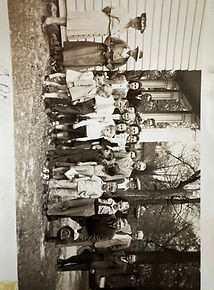
Rock Island Presbyterian Church — circa 1952
This photograph captures a treasured slice of Rock Island Presbyterian Church history from around 1952. Each face represents not just a person, but a life interwoven with this church, this community, and this stretch of time along the Caney Fork. Over the years, names have been lovingly remembered, handwritten lists have been passed down, and memories have surfaced through family stories. Below is the list of individuals we currently have identified in the photo. A few names are still missing—and that’s where you come in. If you recognize someone whose name isn’t listed, or can help fill in one of the blanks, we would be grateful to hear from you. History is best preserved together.
Identified Individuals in the Photograph
1. Wallace Drake
2. Leona Drake
3. Murry Drake
4. Charlie Evans
5. Mae Arnold
6. Eart Dunlap
7. Ernest Moore
8. Mae Moore
9. Georgeanna Howard
10. Sarah Hash
11. Nancy Webb
12. Byran Webb
13. Unknown
14. Anna Mae Hagwood
15. Unknown
16. Rev. Brooks
17. Mrs. Rev. Brooks
18. Melba Breedlove
19. Roy Cornett
20. Aline Cornett
21. Brownie Miller (Mrs. Raleigh Miller Sr.)
22. Unknown
23. Unknown
24. Mrs. C. P. Moore
25. Captain Miller
26. C. P. Moore
27. Unknown
28. Unknown
29. Kendall Hash
30. George Dunlap
31. Clyde Cherry
32. Alvin Hagwood
33. Beatrice Cherry
34. Unknown
35. Bobbie Fisher
36. Pamela Hash
37. Elaine Dunlap
38. ? Breedlove
39. Susan Webb
40. Cathy Fisher
41. Janice Hagwood
42. Ray Fisher
43. Suzanne Dunlap
44. Louise Fisher (Hollins)
45. Barbara Cornett
46. Ms. Cherry
If this photo stirred a memory, sparked a story, or brought a familiar face back into focus, please reach out. Every name added helps keep the living history of Rock Island Presbyterian Church whole for future generations.
